How to Start a Martial Arts School: The Complete Guide
A 10-step plan for opening a martial arts school, six startup costs with real prices, how to add an after-school program, and what to do in your first 90 days.




If you're thinking about opening your own school, you've probably trained for years. You know your art, and you know how to teach it. What you don't know yet is how to start a martial arts school that pays its rent and pays you. That's why you're here.
Opening a school is harder than it was a few years ago. There are now 76,364 martial arts studios in the U.S., up 6.0% in a single year. Over the same year, total studio revenue grew 0.7%. More schools are sharing a market that's barely growing, so a new school needs a plan before it needs a sign.
This guide walks you through how to start a martial arts school in 10 steps, from choosing your students to your grand opening. You'll get the six startup costs to plan for, with real prices we checked. You'll also see how to add an after-school program and what to do in your first 90 days.
- What this covers
- How to start a martial arts school in 10 steps, the six startup costs to plan for, how to add an after-school program, and your first 90 days.
- Why it matters
- There are now 76,364 martial arts studios in the U.S., up 6.0% in a year, while total studio revenue grew 0.7%. A new school needs a plan before it needs a sign.
- What you'll get
- A step-by-step plan, a startup cost table with real prices, and a sample after-school day.
- How we checked
- Every price comes from the seller's or publisher's own page, checked November 9, 2026.
- Who it's for
- Instructors and future owners planning to open their first martial arts school.
How to Start a Martial Arts School in 10 Steps
Opening a school happens in three stages, and the order matters. First, you spend time, not money. You decide who you'll teach and check that the plan can pay you. Next, the money starts going out. You set up the business and commit to a space. Last, you get ready for students. You build your schedule and billing, then fill your first classes before the doors open. Following this order is how to start a martial arts school without signing a lease you can't carry.
1. Choose your style and the students you want to teach
You've probably pictured your school already. Maybe it's a room of six-year-olds in white belts at 4 p.m. Maybe it's a mat full of adults rolling at 7 p.m.
Those two rooms run as two different businesses. The martial arts style you teach decides who walks in and when they train. Kids' programs fill the afternoon and run on belt progression. Adult programs fill the evening and lean on community.
Pick your main group before you look at space. Three choices cover most new schools:
- Kids first: ages 4 to 12, classes after school, with parents as the buyers.
- Adults first: teens and adults, classes in the evening and on weekends.
- Families: kids and adults on one schedule, with family pricing.
Your choice shapes your hours and the space you need. Getting to know your target audience now makes every later decision easier.
2. Size your local market before you look at locations
Your students will come from the neighborhoods around your door. Before you tour a single space, check that enough of the right families live there.
Four checks tell you whether the demand is there:
- Families with kids: count the households with school-age children in the ZIP codes around you.
- Nearby schools: list the elementary and middle schools within a short drive. They're your future after-school students.
- Other schools and gyms: map every martial arts school and kids' activity nearby, with their styles and prices.
- Search demand: check how many people search for your style plus "near me" in your city each month.
Sizing your total local market turns those checks into a number of families you could enroll. If that number is small, look at a different part of town.
3. Write a business plan with real numbers in it
A business plan doesn't need to be long. It needs numbers you've checked. Lenders and landlords will ask to see one, and it tells you if the school can pay you. A free business plan guide from the Small Business Administration walks through the format.
Your plan should answer five questions:
- Who you'll teach: the group from step 1 and how many of them live nearby.
- What you'll charge: monthly tuition for each program.
- What it costs to open: the six startup costs further down.
- What it costs each month: your fixed bills, including rent and your own pay.
- How many students you need: your monthly costs divided by your average tuition. That's your break-even number.
If your break-even number is more students than your space can hold, change the plan now. It's much cheaper to change a plan than to get out of a lease.
4. Register your business and pick a legal structure
Your legal structure decides how you pay taxes. It also decides whether your personal savings are at risk if the school is sued.
Most small schools pick from three business structures:
- Sole proprietorship: the simplest setup. You and the business are legally the same, so your personal assets aren't protected.
- Limited liability company (LLC): keeps business debts separate from your personal assets. Your state sets the filing fee.
- S corporation: a tax choice some owners make once profits grow. An accountant can tell you if it would save you money.
After you register with your state, get a free employer identification number from the IRS. You'll need it to open a business bank account and run payroll. Keep tuition in that account so it never mixes with personal money.
5. Get insurance, permits and liability waivers in place
Martial arts involves contact, so injuries will happen. Three protections need to be in place before your first class:
- Liability insurance: covers injury claims from students and visitors. Ask your landlord what coverage the lease requires.
- Licenses and permits: business license and permit rules vary by state and city. Call your city's business office to check zoning for your space.
- Liability waivers: every adult student signs one, and a parent signs for each child. Digital waivers get signed during online sign-up and stay on each student's profile.
Insurance prices are in the cost section below. Get quotes from at least two insurers who work with martial arts schools.
6. Find a location and sign a lease you can carry
Rent is likely to be your biggest monthly bill, so this is the step to slow down on. Look for a space that fits the plan you wrote:
- Open floor: room for your mat area plus a lobby where parents can wait.
- Ceiling height: high enough for jumping kicks and throws.
- Parking and drop-off: a safe place for parents to pull in at 5 p.m.
- Visibility: a storefront that families pass on the way to school.
Before you sign, ask the landlord for a tenant improvement allowance. That's money the landlord puts toward your build-out. Ask for a few months of free rent while you build, too. Have a lawyer read the lease, especially any personal guarantee.
7. Set your class schedule, programs and pricing
Your programs are what you sell. Most new schools start with a few:
- Little ones (ages 3 to 5): short 30-minute classes built on listening and coordination.
- Kids (ages 6 to 12): belt classes after school, two or three times a week. Set up belt tracking with your curriculum so kids and parents can see progress.
- Teens and adults: evening classes, often with sparring.
- Private lessons: one-on-one time, sold in packs of five or 10.
Price each program as monthly tuition. Three pricing choices to make before you open:
- Monthly membership: one price a month, billed automatically.
- Paid-in-full discount: a lower total for families who pay six or 12 months up front.
- Family discount: a lower rate for each added sibling.
Build the timetable in your class scheduling software so parents can see open spots and book a trial online.
8. Set up enrollment, billing and attendance before opening day
It's the Saturday before you open. Twelve families want to sign up, and you're writing their card numbers on a clipboard. Every one of those families will need to be entered again later.
Avoid that by setting up your studio management software before opening day. Four things need to work before your first trial class:
- Online sign-up: parents pick a program, sign the waiver and pay from their phone.
- Recurring billing: automatic monthly billing charges each family on the same day and retries declined cards.
- Attendance check-in: students check in at a kiosk or in the app, so you know who's showing up.
- Lead tracking: every trial request lands in one list, with a follow-up date.
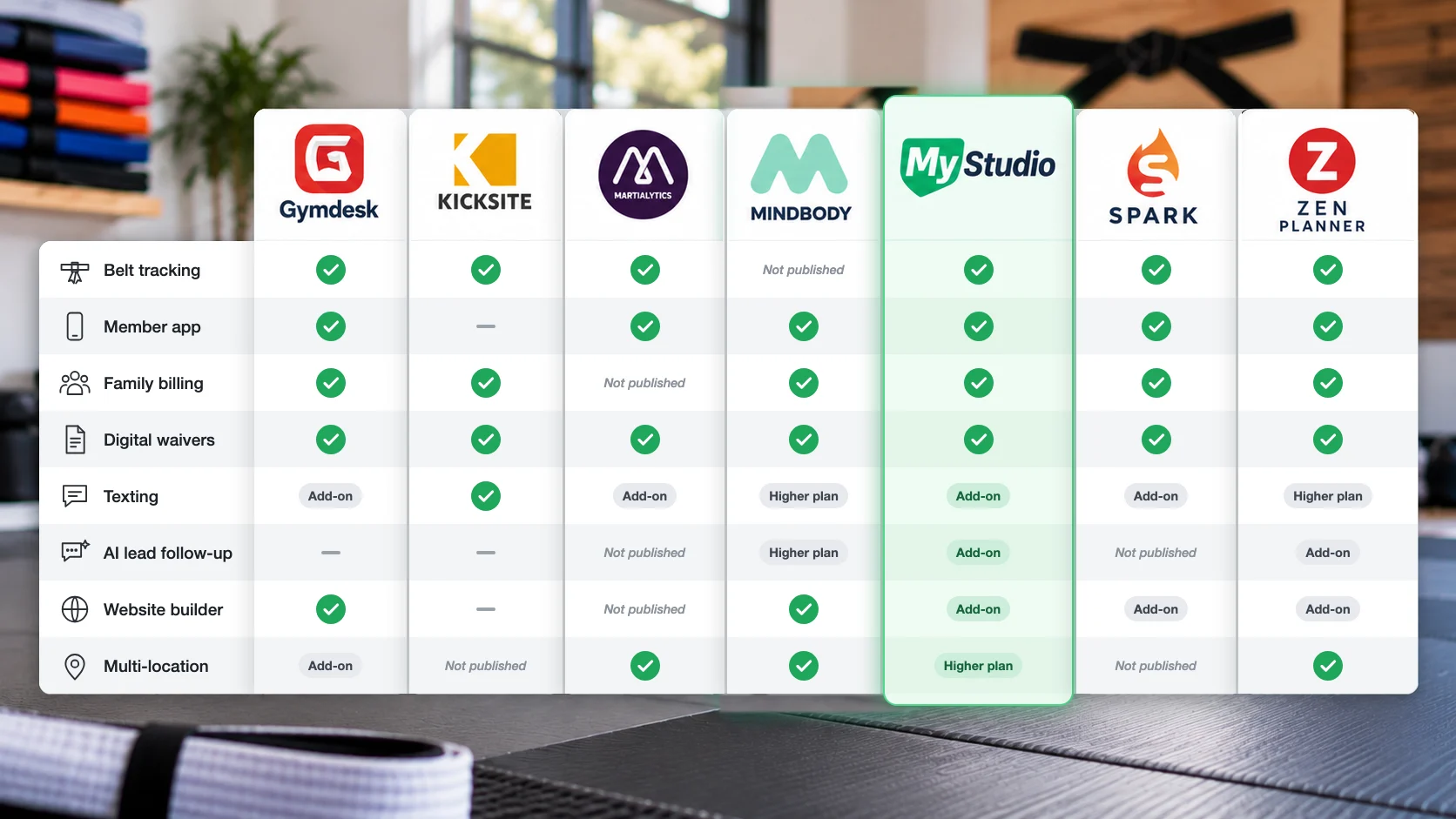
Comparing martial arts software before you open saves you a switch later. Switching after you open means setting up every family again.
Families pick a program, sign the waiver and pay from their phone, so nothing gets typed in twice after you open.
Get a demo
9. Market your school and pre-sell founding memberships
Families need to know you exist before your doors open. Start these about 60 to 90 days before opening:
- Google Business Profile: claim your free profile as soon as you have an address, and fill out every section. Add photos of the build-out as it happens.
- Website with trial booking: a simple site with your schedule and a button to book a trial. A website builder made for studios connects that button to your sign-up.
- Local partnerships: introduce yourself to nearby elementary schools, PTAs and pediatric offices.
- Social posts: share the build-out week by week, so neighbors watch the school come together.
These channels are the start of your martial arts marketing plan, and they keep working long after opening day.
A founding membership is a pre-opening offer for your first families. Three ways to set it up:
- Founding rate: a lower monthly price, locked in for as long as the family stays enrolled.
- Founding bundle: a free uniform and a reduced first month for families who join before opening.
- Limited spots: cap the offer at your first 50 families, so there's a reason to sign up now.
Ask your founding families to bring a friend to class. Getting more students without a hard sell starts with these first families.
10. Plan your grand opening
Your grand opening turns pre-sale interest into trial classes. Plan it about two weeks out and give it a clear schedule:
- Free demo classes: short sessions for each age group, on the hour.
- Instructor demonstration: your team shows what students will learn at each belt.
- Same-day offer: the founding rate for families who enroll that day.
- Next-day follow-up: every family who visits gets a text the next morning.
Put someone at a tablet to sign families up, so no one waits in line. Count how many visitors book a trial, and how many trials enroll. Those two numbers tell you how well the day worked.
How Much Money You Need to Start a Martial Arts School: 6 Costs to Plan For
How much money you need to start a martial arts school depends mostly on your rent and build-out. Those two costs change the most from city to city. The other costs are easier to price ahead of time.
Mats for a 1,000-square-foot floor run about $6,900. Liability insurance in one national program starts at a $750 minimum premium a year. Your budget should also hold at least one year of monthly expenses.
The table below lists all six costs, with a starting figure where we found one, and the sections after it show how to get your own number for each.
One column per cost. Tap a group to open or close it.
| Startup cost | Lease, deposit and build-out | Mats, equipment and uniforms | Insurance, permits and legal fees | Software and payment processing | Marketing before you open | Cash to cover your first months |
|---|---|---|---|---|---|---|
| What it covers | Rent, security deposit, walls, flooring, restrooms, signs | Mat floor, bags and pads, starter uniforms, lobby | Liability policy, state filing fee, local permits, lawyer and accountant | Sign-up, billing, attendance, waivers, card fees | Website, Google profile, signs, ads, grand opening | Rent, payroll, software, your own pay |
| Typical cost | Shopping center space averages about $25.82 per sq ft a year | 1.5-inch tatami mat: $160 each, $147 at 40 or more. About $6,900 for 1,000 sq ft | One national program: $18.90 per student a year, $750 minimum, $1 million coverage | MyStudio: Starts at $79 for unlimited students. Card rates starting from 2.9% + $0.30 | Varies most by market. No standard price | At least one year of monthly expenses |
| How to get your number | Landlord and contractor quotes | Measure your mat area, then quote gear | Two insurance quotes, plus your state and city fee schedules | Compare plans at the size you expect to reach | A fixed number in your business plan | Your monthly costs times 12 |
Every figure was checked on the seller's or publisher's own page on November 9, 2026. Rent and build-out vary the most by city, so get local quotes.
1. Lease, deposit and build-out
Rent sets most of your monthly budget, so price it first. Nationally, shopping center space averages about $25.82 per square foot. Commercial rent is quoted per square foot per year. At that rate, a 2,000-square-foot space costs about $51,600 a year, or $4,300 a month. Rent in your area can be much higher or lower.
Plan for two more lease costs:
- Security deposit: set by the landlord in the lease. Get the amount in writing before you sign.
- Build-out: walls, restrooms, flooring under the mats, lighting and signs. Get at least two contractor quotes, then subtract any tenant improvement allowance.
2. Mats, equipment and uniforms
Your mat floor is the biggest equipment cost. A 1.5-inch tatami mat costs $160 and covers about 21.5 square feet. The price drops to $147 a mat when you buy 40 or more. A 1,000-square-foot mat area takes about 47 mats, or roughly $6,900 before shipping.
Price these next:
- Training gear: heavy bags, kick shields, focus mitts and sparring gear for the classes you'll run first.
- Starter uniforms: many schools include one with enrollment. Build the cost into your enrollment fee.
- Lobby and cleaning: chairs for waiting parents and cleaner for the mats.
Buy what your first classes need, and add gear as programs fill.
3. Insurance, permits and legal fees
Liability insurance for a martial arts school is often priced per student. One national program charges $18.90 per student a year, with a $750 minimum premium for $1 million in coverage. A new school with 30 students pays the minimum. At 100 students, the premium is about $1,890 a year.
Set money aside for these, too:
- State filing fee: your state charges a fee to form an LLC or corporation. The amount varies by state.
- Local permits: your city may require a business license and a certificate of occupancy for your space.
- Legal and accounting: a lawyer to review the lease, and an accountant to set up your books.
4. Software and payment processing
Your software runs sign-up and billing, so it's a monthly cost from day one. Watch how each plan's price changes as you grow. Some martial arts school software raises the price as your student count rises. MyStudio's plans start at $79 per month, with unlimited students on every plan.
Card processing adds a fee to every payment. MyStudio's rates start at 2.9% plus 30 cents per payment. Ask every company for its card rate in writing, because many don't publish it.
5. Marketing before you open
Pre-opening marketing has no standard price, so set the number from your plan. Decide how many founding members you need, then budget for the channels that reach those families.
Four costs to budget for:
- Website and trial booking: a site with your schedule and a trial button. Check whether your software already includes one.
- Signs and print: a storefront sign and flyers for local schools and businesses.
- Paid ads: a small local budget aimed at parents within a few miles of your school.
- Grand opening event: demo classes, snacks and a giveaway.
Track which channel brought in each founding family. That tells you where to spend after you open.
6. Cash to cover your first months
Tuition takes time to build, and your bills start on day one. When you estimate startup costs, count at least one year of monthly expenses. That cash keeps the school open while enrollment grows.
Add up these monthly costs to find your number:
- Rent and utilities: your lease payment plus power, water and internet.
- Payroll: instructors and front desk staff, if you have them.
- Recurring bills: insurance, software and card fees.
- Your own pay: the amount you need to live on each month.
Multiply the total by 12. If that number is out of reach, look for a smaller space or pre-sell more founding memberships.
Starting a Martial Arts Business With an After-School Program: 5 Steps
After-school care is one of the hardest things for working parents to find, which makes it a high-demand option to consider as you plan your school. Parents of almost 30 million kids want an afterschool program, and over 75 percent of those children don't have access to one.
You don’t have to have an after-school program to run a lucrative martial arts studio, but if you want one, plan for it before you sign a lease, because it will directly affect your licensing, staff and schedule. If you add one, starting a martial arts business with an after-school program requires you to take five additional steps.
1. Check your state's child care licensing rules
Do this before you take a single deposit. Each state sets its own child care licensing rules, and states define license-exempt programs in different ways. A program that's exempt in one state may need a license in the next.
Call your state's child care licensing office and ask four questions:
- License or exemption: does a program like yours need a child care license, or is it license-exempt?
- Staff checks: what background checks and training do your staff need?
- Supervision: how many children can each adult supervise?
- Space rules: are there requirements for restrooms, exits or snacks?
Get the answers in writing and keep them on file.
2. Arrange safe pickup from nearby schools
It's 2:45 on a Tuesday. Eight kids are waiting at two different schools, and your class starts at 3:30. Pickup is the first thing parents will ask about, so have the answer ready.
Three pickup options work for most schools:
- Walking pickup: staff walk students over from schools within a few blocks.
- Van pickup: your own van and trained drivers, for schools farther away. Ask your insurer whether your liability policy covers the van, or whether it needs its own auto policy.
- Parent drop-off: parents bring kids to you straight from school.
Whichever you choose, keep a sign-out list. Only approved adults should pick up each child.
3. Build a daily schedule around training and homework time
A good after-school day mixes martial arts with the things parents need done. Here's a sample afternoon:
- 3:00 p.m., arrival and snack: kids check in and eat.
- 3:30 p.m., homework time: quiet tables, with staff to help.
- 4:15 p.m., martial arts class: a regular belt class with your instructors.
- 5:15 p.m., games and character lessons: active games and a short lesson on focus or respect.
- 6:00 p.m., parent pickup: each child signs out with an approved adult.
Kids in the program can join your evening classes too. That keeps each child moving toward the next belt.
4. Price the program as monthly tuition
Charge one monthly fee, billed automatically. Families compare it to other after-school care, so check what local programs charge first.
Four pricing options to offer:
- Five-day plan: full price, every school day.
- Two-day or three-day plan: a lower monthly price for families with set days.
- Sibling rate: a discount for each added child.
- Registration fee: a one-time fee that covers a uniform and supplies.
Bill on the same day every month, and collect a deposit to hold each spot.
5. Enroll families before the school year starts
Families need their after-school plan before the first day of school, so open enrollment in spring. Three ways to fill spots early:
- Early-bird rate: lower tuition for families who enroll by a set date.
- Summer camp roll-over: offer camp families a spot in the fall program.
- Back-to-school nights: set up a table at nearby schools' open houses.
Software for after school programs can run online registration with early-bird pricing and sibling discounts. Parents sign up and pay at night, and you see the roster in the morning.
Open fall enrollment in spring with early-bird pricing and sibling discounts, and parents can sign up at 9 p.m. without a phone call.
Get a demo
Your First 90 Days After Opening a Martial Arts School
The first 90 days after opening a martial arts school decide how many of your first families stay. Four habits make the difference. Each one takes a few minutes a week once it's set up.
Follow up with every trial within a day
Your Saturday trial class went well. Three kids tried it, and their parents said they'd think about it.
A parent who doesn't hear back may book a trial somewhere else. Reply the same day, and offer a second class or the founding rate. AI lead follow-up texts new leads back in seconds and books the trial while you're on the mat. Count how many trials become members each week, so you know whether the follow-up is working.
Track attendance to catch students before they quit
Missed classes are the earliest sign that a student may quit. Attendance tracking flags students who stop showing up, so you can reach the family that week.
Set up three steps for every flagged student:
- Set a rule: for example, two missed weeks starts a check-in.
- Contact the parent: call or text to ask how things are going.
- Invite them back: offer a make-up class or a free private lesson.
Ask happy families for reviews and referrals
A new school opens with zero reviews, so each one counts. Ask for a review right after a student earns a new belt. Steady Google reviews help a new school show up when parents nearby search for classes.
Two referral offers work well in the first months:
- Referral credit: a free month for families who bring a new student who enrolls.
- Bring-a-friend week: students invite a friend to class for free.
Review your numbers every month
Pick one day each month to check how the school is doing. Start with the three KPIs every studio owner should track, and add these four numbers:
- New members: how many joined, and where each one came from.
- Cancellations: who left, and why.
- Trial conversion: the share of trials that became members.
- Revenue against break-even: whether you're above the number from your business plan.
Studio reporting and analytics pulls these numbers from your sign-ups and billing, so you don't build a spreadsheet by hand.
AI texting replies to new leads while you teach, and attendance alerts flag students who stop showing up that week.
Get a demo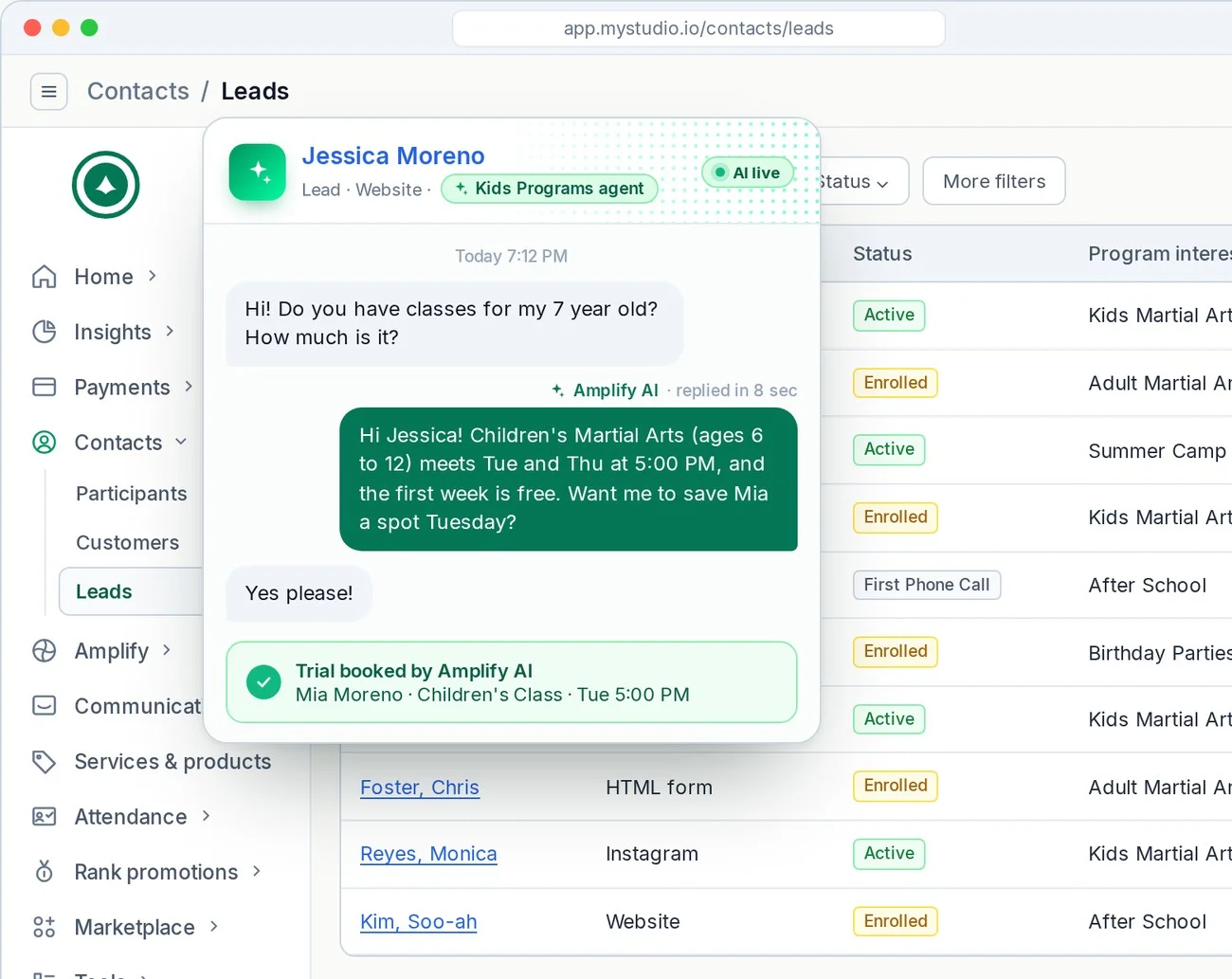
Conclusion: Start Your Martial Arts School With Your Systems Ready on Day One
Knowing how to start a martial arts school means having a plan with real numbers in it. It also takes systems that keep families enrolled after opening day. Owners who set both up before they open spend their first months teaching.
MyStudio gives new schools those systems from the start. Starting a new school with MyStudio means online sign-up and automated billing are ready for your first family. Its onboarding team helps you set up your programs and pricing.
Book a demo and see how MyStudio would run your school on day one.
Frequently Asked Questions About Starting a Martial Arts School
How much money you need to start a martial arts school depends most on rent and build-out in your area. Mats for a 1,000-square-foot floor cost about $6,900. Liability insurance in one national program starts at a $750 minimum premium a year. Include at least a year of monthly expenses in your estimate, so you can pay bills while enrollment builds.
Start by checking your state's child care licensing rules, since they vary by state. Set up safe pickup from nearby schools, and plan a daily schedule with homework time and a martial arts class. Price it as monthly tuition, and open enrollment in spring so families can plan before school starts.