Martial Arts Marketing: The Complete Guide
Martial arts marketing is the system a school uses to get found by the right families, turn interest into booked trial classes, and turn those trials into long-term students.




Your martial arts marketing playbook, start to finish
- What this covers
- The 14 strategies that actually grow a martial arts school, from local search and reviews to events, referrals, and automated follow-up, plus why marketing matters and where to start.
- Why it matters
- 97% of consumers read reviews before choosing a local business, and referrals eventually hit a ceiling. Marketing is the part of enrollment you can influence on purpose.
- What you'll build
- A repeatable system across four jobs: getting found, creating demand, following up automatically, and knowing what's working.
- What's included
- The channels worth starting with and the founders' own playbook, the same one they used to grow InCourage past $1M per location.
- Who it's for
- Single-location studio owners and multi-location operators who want steady, predictable enrollment without a marketing team.
97% of consumers read reviews for a local business before choosing one, and 41% say they always do. So by the time a parent calls your school, they have already looked you up, read what other families wrote, and decided whether you are worth the drive.
You know how to run a great class. The harder question is where the next twenty students come from, and whether you can answer that reliably enough to plan payroll around it.
Here is what stalled growth usually looks like from the inside. Referrals slow down when your current families run out of friends to tell. A franchise opens across town with a real ad budget. A parent fills out your trial form on a Saturday night, hears nothing until Monday, and books somewhere else in between.
Martial arts marketing is the system a school uses to get found by the right families, turn interest into booked trial classes, and turn those trials into long-term students. It runs on four things working together:
- Findability: a website and local search presence that put you in front of families searching right now.
- Demand: organic and paid channels that create interest before anyone starts searching.
- Follow-up: automatic responses, so no lead sits waiting on someone to remember.
- Measurement: tracking that shows which of it is paying for itself.
Everything below is built to be run by the person already teaching the classes. It is the same martial arts marketing playbook our founders used in their own schools to build them to over $1M ARR each.
5 Reasons Marketing for Martial Arts Schools Matters
If you teach most of your own classes, marketing is the task you get to after the last class of the night, and it is easy to skip for a month when the roster looks full. A full roster today does not tell you much about next spring, because the things that change it happen outside your school, while you are on the mat teaching.
Marketing for martial arts schools matters because five of those outside forces are changing enrollment at the same time, and each one affects how many families find you and how many stay. Let's dive into each.

1. Martial arts competition is growing rapidly
New schools are opening faster than the money is growing. From 2021 through 2026, the number of U.S. martial arts businesses grew at a 15.3% annualized rate, more than double the industry's 6.3% revenue growth over the same period.
This is the reality:
- More schools, slower-growing revenue: the same pool of families gets split more ways every year.
- More than 72,000 studios nationwide: with no single company holding more than 5% of the market.
- Your competition is local: without a dominant national brand, the school taking your next student is the one across town.
2. Parents want after-school programs they can't find
Demand is not your problem. Parents of almost 30 million children want an after-school program, more than half the school-age kids in the country, and over 75% of them cannot get access to one.
Martial arts schools are built for exactly that need: a supervised, structured, skill-building hour that runs while parents are still at work. Four things usually keep those families out of your classes:
- Affordability: tuition and gear land differently for a family weighing several programs.
- Convenience: class times that miss the 3 p.m. to 6 p.m. window miss the demand.
- Transportation: getting a child from school to your mat is a real barrier.
- Availability: plenty of families near you don't know your program exists.
Only the last one is a marketing problem, and marketing solves it outright. The other three are worth answering directly in your messaging instead of leaving parents to guess.
3. Parents do intensive online research
A parent's decision is mostly finished before you know they exist. Here is the order they usually go in:
- Reviews first: 41% of consumers say they always read them when researching a local business.
- Social proof second: 85% become more likely to use a business after seeing positive feedback.
- Your website last: by the time they land there, they are confirming a decision they mostly already made.
Your review profile is selling for you on nights and weekends, whether or not anyone is watching it.
4. Your school can't grow on referrals alone
Referrals are the highest-converting leads you will ever get, and they are the ones you control least.
That makes them a great channel and a poor plan. Three things cap the volume, and none are yours to adjust:
- Size: the pipeline is only as big as your current families' social circles.
- Timing: you cannot schedule the playground conversation where your school comes up.
- Readiness: the family being told may not be looking for a program right now.
The ceiling arrives quietly, usually as a quarter that just feels slower than the last one. Keep referrals strong, and track every lead source through to enrollment so you know what is actually producing students. Sizing your local market is how you see it coming before enrollment flattens.
5. Attrition never stops, so enrollment can't either
Students leave for reasons that have nothing to do with your teaching. Kids age out, families move, a soccer season takes the weeknight.
Even a school with strong retention starts every year needing to replace part of its roster before it grows at all. That is what makes marketing a standing job rather than something you do when classes look thin.
- Replacement comes first: new students cover attrition before any of them count as growth.
- You feel it late: you feel it a quarter after it starts.
- Steady beats seasonal: a school that only markets in January spends the rest of the year behind.
Those five pressures land on every school in the world, including the good ones. Being the best school in your area and being the school families choose are two different jobs, and only one of them happens on the mat.
Predictable enrollment starts with faster follow-up
MyStudio captures every lead and follows up automatically, so even a Saturday-night inquiry gets a reply in seconds and a trial on the calendar.
Get a demo New leadSMS
How to Market Your Martial Arts School: 14 Proven Strategies
None of that is news to you. You already know you want more families walking through the door. The real question is how to market your martial arts school without adding a second full-time job to your week, and the honest answer is to start small: pick two or three martial arts marketing strategies, run them until they are a habit, then add the next. Studios that launch everything at once end up running nothing.
Three weeks in is usually where it breaks. The posting stops, the follow-up slips, and it starts to feel like martial arts marketing just does not work for a school like yours.
Here are fourteen martial arts marketing ideas worth choosing from, roughly in the order most schools add them.

1. Win local search with Google Business Profile
When a parent Googles "martial arts near me," the map results sit above every website on the search results page. Your Google Business Profile fills those results, so more parents see it than see your website. Getting into that map pack and staying there takes two things:
- A complete profile
- A steady flow of recent reviews
Building out your Google My Business profile
Your primary category is the single most influential local ranking factor, so pick the one a parent would actually search. "Martial arts school" ranks differently than "Gym" or "Fitness center." From there, fill every field: real class times, service area, the styles you teach, and photos of real classes instead of your logo. Then keep your name, address, and phone number identical everywhere, your profile, your site, and any old directory listings. Get this right once and you rarely touch it again.
Start collecting Google Reviews for your studio
Reviews are often what decide whether a parent calls or keeps scrolling. The hard part isn't getting one review. It's getting them consistently. That comes down to two habits: asking at the right moment, and automating the ask so it actually happens. The schools that stay visible get three things right:
- When you ask: right after a proud moment. A belt promotion, a first tournament, or a breakthrough class is when a family is gladdest they chose you.
- How you ask: an automated text or email that fires on that moment. A paper slip at the front desk gets forgotten.
- Then reply: someone responds to every review, because Google and the next parent are both reading.
MyStudio sends that review request automatically off a logged belt promotion or an attendance milestone, so the ask goes out every time without anyone remembering. Our guide to Google reviews for local businesses covers the scripts, the exact timing, and how a steady stream of reviews keeps you showing up.
Thirty minutes of profile maintenance a month, plus a review request running in the background, does more for your local visibility than most martial arts advertising you could buy.
2. Build a website that converts
Reviews get a parent interested. Your website is where they decide. It's where they land after an ad, a social post, or your Google listing, and it's the last thing most parents check before they reach out, so it's the foundation of the rest of your martial arts marketing.
It has about a minute to answer three questions: what you teach, when you teach it, and what it costs. Most studio sites cover the classes in detail and bury the schedule and the pricing. Whether a parent gets from your homepage to a booked trial without picking up the phone comes down to five things:
- Fast load times: a page that loads in one second converts three times better than one that takes five. A parent waiting on your photo gallery is a parent going back to the search results.
- A current class schedule: the most-visited page on most studio sites, and the one most likely to be out of date.
- Visible pricing: hiding it reads as a sales trap and costs you every family that hates calling to ask.
- Real photos and testimonials: the same proof they just read in your reviews, now in your words.
- A clear way to sign up: the moment a parent decides, the next step has to be right there. Make them hunt for it and you lose them.
That last one is where martial arts school marketing quietly leaks. A parent ready to enroll shouldn't have to call, wait, or dig, but on most studio sites, that's exactly what signing up takes.
A website built for martial arts schools puts what you teach, when, what it costs, and how to join on one fast, current page, so the parent who just read your reviews can act while they're still sold.
3. Make signing up effortless
Getting a parent to your sign-up page is the hard part. Converting them once they're there shouldn't be.
Most studios still gate the sign-up: fill out a form, wait for a callback, come in to pay, sign paperwork on the mat. Every one of those steps is a place a ready-to-enroll parent slips away, and most of them are asking to sign up outside your office hours anyway.
The schools that convert let a parent go from interested to enrolled in one sitting:
- Let them look before they commit: show programs, schedules, and prices up front.
- Book and pay in the same flow: a trial, a membership, or an event should close in a few taps, not a phone call and a second visit.
- Handle the paperwork online: digital waivers and forms get signed before the first class, not clipboarded at the door.
- Keep it open after hours: most sign-ups happen at night and on weekends. Your enrollment has to run even when you’re out of office.
This is where a purpose-built system earns its keep. With MyStudio's automation tools, a parent browses, books, and signs the waiver in one flow. The enrollment is in your system before you open your laptop. No form sitting in an inbox. No callback that never happens.
4. Host events that fill your mat
Ask most owners where their best leads come from and the answer isn't ads, it's events. A birthday party, a parents' night out, a fundraiser in your lobby, these put families inside your studio, having a great time, before anyone's asked them to sign up. That's a warmer lead than any campaign can buy.
The events that work fall into two buckets: ones you host, and ones you show up to.
Host events at your studio
These are your highest-converting lead generators, because the family is already on your mat, seeing exactly what you offer:
- Birthday parties: a room full of kids having the best afternoon of the month, and a parent for each of them watching your instructors in action.
- Parents' nights out: a few kid-free hours for parents while your team runs games and drills. You earn goodwill and a lobby full of prospective students.
- VIP and bring-a-friend parties: current students each bring a friend. The friend gets a great first impression, the student feels like a VIP, and you get a room of pre-qualified leads.
- Themed fundraiser nights: a glow dodgeball night on back-to-school, a Valentine's event, a summer kickoff. Fun enough that families come for the night and remember the school.
Show up where families already are
Then take the studio to them, in front of parents who haven't thought about martial arts at all:
- School and PTA partnerships: free classes or a demo at a local school reach more local families than most paid campaigns, and a board-breaking booth at a fundraiser does the same.
- Farmers markets and sidewalk demos: low lift, high visibility, in front of people who were never searching for you.
- Concern-based seminars: abduction avoidance, bully defense, and self-defense confidence show parents what martial arts actually does for a child, and draw the ones who'd never book a free trial.
Wherever you show up, knowing your families well enough to name where they spend a Saturday is what separates an event that fills a room from one you staff for four hours and leave empty.
One rule holds for all of it: an event only counts if you leave with names. Put a QR code to your trial page on every table, follow up within 48 hours, and add a bring-a-friend hook so each event feeds the next.
5. Partner with local schools and community groups
Partnerships are the most underrated marketing for martial arts schools. An event you run reaches the families who show up; a partnership reaches the families a school or PTA already has, and you arrive with their stamp on you. A flyer in a backpack or a mention in the PTA newsletter is trust you can't buy with an ad.
The best partners are the groups already gathering the families you want:
- School PTAs and PTOs: your highest-value partner. Run the activity at their fundraiser, donate a session of classes to their raffle, or put on a free self-defense workshop for parents. One afternoon can put you in front of hundreds of local families.
- Preschools and daycares: their kids are aging right into your programs. Offer a monthly class on-site or a parents' night, and you become the school they recommend.
- Scouts, churches, and libraries: built-in groups of kids who need badge activities, after-school options, and something to do on a weekend.
Whatever the partner, give before you ask. Lead with something their families actually want, and make it easy to say yes: bring the equipment, run the activity, handle the setup. Then track which partner sends which students, so next season you spend your time where it paid off.
6. Grow organic reach on social media
Social media is the cheapest reach in martial arts marketing and the easiest to abandon. Parents are on Facebook and Instagram. Their kids are on Reels, TikTok, and Shorts. You need to be on socials, and luckily, you don’t need a camera crew.
What separates a studio page that grows from one that stalls comes down to four habits:
- Hook in the first two seconds: short-form rewards a strong opening over a polished edit, so lead with the throw, the board break, or the kid's reaction. Our breakdown of short-form content strategy goes deeper per platform.
- Post on a rhythm you can hold: one post a week every week beats daily for two weeks and then a month of silence.
- Mix in more than promotion: InCourage Martial Arts runs class updates, student milestones, and community posts alongside anything selling, which is why the page reads like a school.
- Let parents post for you: a parent's video of their kid's first belt test reaches families your account never will, and user-generated content is the cheapest local reach there is.
Ten seconds of class footage, one-three times a week, filmed by whoever is already standing on the mat. That is the whole production requirement.
7. Run paid ads on Google and Meta
Paid ads reach families who have never heard of you, in days instead of months. They are also the one strategy where you can spend real money and get nothing back, which is why so many studios try them once and quit.
Adding your credit card is the easy part. What actually decides whether the money comes back:
- Creative and audience testing: your first ad is a guess, and everyone within ten miles performs nothing like a lookalike built from your current families.
- Negative keywords: without them you pay for "karate kid streaming." That alone can eat half a budget.
- Landing page match: a free-trial ad has to land on a free-trial page, not your homepage.
- Weekly upkeep: costs climb and audiences fatigue. Ads left alone get expensive quietly.
That is a real job, which is why most owners are better off handing paid to a freelancer or a local agency. What you spend learning it yourself is usually more than the fee.
Want to DIY? Three platforms are worth your testing, and they do different jobs:
- Google Search ads: catch families typing "martial arts classes near me." Highest intent, highest cost per click.
- Meta ads: better for awareness and for retargeting people who visited and did not book.
- Nextdoor: cheaper and hyper-local, which suits a school running on neighborhood word of mouth.
Start small with Google Search only. Use a free trial as your offer, and target a radius within driving distance. Get conversion tracking live before the first dollar and cap the budget at a number you would not miss.
8. Launch a referral program among current students
Referred students close faster and stay longer, because they arrive with someone they trust already vouching for you. The usual mistake is mentioning the program once at sign-up and never again.
Setting one up takes four decisions:
- Pick a two-sided offer. A free month, gear, or a waived testing fee for both the referring family and the new student. One-sided offers feel like you are using your families.
- Name the moment you ask. Right after a belt promotion or a great class, when families are already proud. Put it on the calendar beside your testing dates so it happens on purpose.
- Give them something to send. A shareable link or a card with a code, never "tell them to mention your name at the front desk."
- Give your staff the ask. One sentence they can say at the door, the same way every week.
Then track it, or you will not know whether it works:
- Tag every lead with a source, so a referral is distinguishable from a Google click.
- Credit the referring family automatically, so the reward does not depend on someone remembering who sent whom.
- Watch referral share of enrollments month over month. If it stays flat while your student count grows, nobody is actually asking.
Lead source tracking is what turns this from a good intention into a channel you can compare against the others.
9. Send targeted email marketing campaigns
Email is for the families who are interested and not ready, which at any given moment is most of your pipeline. Almost none of it should be written the week you send it.
Four campaigns cover most of what a studio needs, and each fires off a trigger rather than a calendar reminder:
- Lead nurture: starts the moment a parent fills out your trial form, answers the questions that stall a decision, and keeps going over days and weeks instead of one follow-up call.
- Retention: watches attendance and reaches out when a student starts slipping, before they mentally quit. This is the campaign most studios never build and the one that protects the most revenue.
- Win-back: goes out a few weeks after a student stops showing up, which costs almost nothing and regularly brings families back without an awkward cold call.
- Seasonal and event campaigns: summer camps, belt testing, back-to-school enrollment, sent to the segment that should actually see them.
What separates a newsletter tool from marketing automation built for martial arts schools is what the trigger can see. Attendance, enrollment status, and lead source all live in the same system, so a lapsed student and a cold lead never get the same message, and a retention campaign can fire off a missed class instead of a guess. The same sequence can run over email, text, or push, depending on what a family actually responds to.
10. Use text and SMS marketing to re-engage prospects
Over 90% of text messages get opened, most within minutes. Nothing else you own moves that fast, which makes text the channel for anything with a deadline attached:
- Trial reminders the morning of class.
- Same-day changes, like a cancellation or a room switch.
- Short enrollment windows that need a fast response to matter at all.
That speed is also why text marketing for martial arts studios goes wrong when it is overused. Weekly promos train families to ignore you, and the channel stops working right when you need it most. Two-way texting built into member communication keeps replies attached to the right student record.
11. Offer a free trial that converts to full membership
A one to two week trial lets a student experience a class instead of watching one. What converts it is almost never the trial itself. It is the three conversations around it:
- The welcome: a scripted first class that sets expectations from day one.
- The mid-trial check-in: catches hesitation before it hardens into a no.
- The close: a low-pressure conversation about next steps before the trial period ends.
InCourage Martial Arts, our founders’ own schools, still runs its free trial this way. Trial-to-member conversion is a coaching skill, and it deserves its own tracked number rather than living in someone's memory, which is what sales enablement tools make visible.
How InCourage booked 1,156 free trials with no ad spend
See the free-trial and follow-up system behind the numbers, and how they turned trials into enrolled students without buying a single ad.
Read the case study12. Launch a branded membership app
An app under your school's name signals the same professionalism families already judged your website on. The features that actually get used are the boring ones:
- Class booking, so a schedule change is not a phone call.
- Payment updates, so an expired card stops being your problem to chase.
- Belt and rank progress, so a student can check where they stand between classes.
Every one of those is a call your front desk stops taking. A white-label member app does it without building software from scratch.
13. Tailor your marketing by program type
One pitch across every program wastes ad spend, because the person making the decision is different each time.
- Karate, taekwondo, and traditional programs: sell on family positioning, with belt progression as visible proof of a child's growth and confidence.
- BJJ and grappling: skew adult and convert on community and challenge, since the buyer is deciding for themselves.
- Kickboxing, Muay Thai, and MMA fitness: market as a workout first, which puts you against gyms as much as other martial arts schools.
Marketing martial arts to an adult buyer and marketing to a parent are two different jobs, and getting it right starts with knowing why your school is the obvious choice for each group, which is the work of defining your unique value proposition.
14. Automate your marketing with software and a CRM
Every strategy above works better when less time passes between a parent raising their hand and someone answering. That delay is where most studio leads die, and it's rarely a discipline problem. The person responsible for follow-up is also teaching the 6 p.m. class.
It's worse than it sounds, because parents rarely inquire during business hours. They're filling out your form after hours. A lead that waits until morning is often a lead that's already booked somewhere else. You can't out-hustle that by checking your phone more. You need a system that answers when you can't.
That system does three things:
- Capture: every lead lands in one place the moment it arrives, from any channel, with nobody logging it by hand.
- Respond: the first reply goes out in seconds, at any hour, and the next few follow on schedule whether or not anyone remembers.
- Handoff: your team picks up a warm conversation instead of a cold form submission.
Speed is the part families notice, and it's what lets them decide while they're still sold. AI-powered lead response answers within seconds day or night, so the parent who inquires at 9 p.m. is talking to your school that night, and can book the trial before they've closed the tab. Our digital marketing tactics for fitness businesses covers more of what martial arts digital marketing looks like once it runs itself.
Conclusion: Start Building Your Martial Arts Marketing System
You do not need a marketing team to grow a martial arts school. You need the parts that do not require your judgment to run without you, so your attention goes to teaching and to the conversations that actually close.
MyStudio was built by people who ran this playbook first. Tu and Linnette Le grew InCourage Martial Arts into multiple $1M+ locations without a marketing department, then built MyStudio for martial arts schools so other owners could run the same thing without assembling it from six vendors.
See what it looks like against your own schedule, pricing, and enrollment numbers. Book a demo and we will walk through it together.
Everything your studio runs on, in one place
MyStudio brings your sign-ups, billing, scheduling, messaging, and reporting into one platform, so the same data flows everywhere without anyone copying it between apps by hand.
Get a demo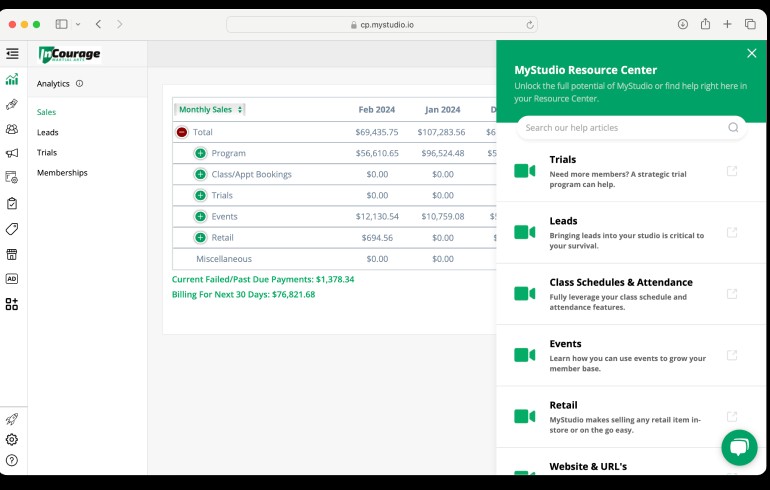
Martial Arts Marketing FAQ
Marketing martial arts to adults works best when you lead with fitness, stress relief, self-defense, and community, since those are the reasons adults actually sign up. Most adults are weighing your class against a gym membership, so run adult-only class times on an evening or lunchtime schedule and make the conditioning and confidence benefits easy to see. Corporate wellness partnerships and a free intro session or two reach working adults who would never walk into a program marketed for kids.
Start with the three channels that cost the least and compound the fastest: a website that takes bookings, a complete and actively reviewed Google Business Profile, and a referral program among current students. Layer in paid ads, email and text follow-up, and community events as you get the bandwidth, and put a CRM underneath all of it so no lead depends on someone remembering to call back.
The martial arts marketing ideas that perform most consistently are board-breaking demos and instructor booths at school fundraisers and community events, because they reach families who were not searching for classes. Sidewalk chalk challenges outside the studio, pop-up self-defense demos at farmers markets, and parents' night out events work for the same reason, and each pairs an attention-grabbing moment with an easy path to book a trial.